

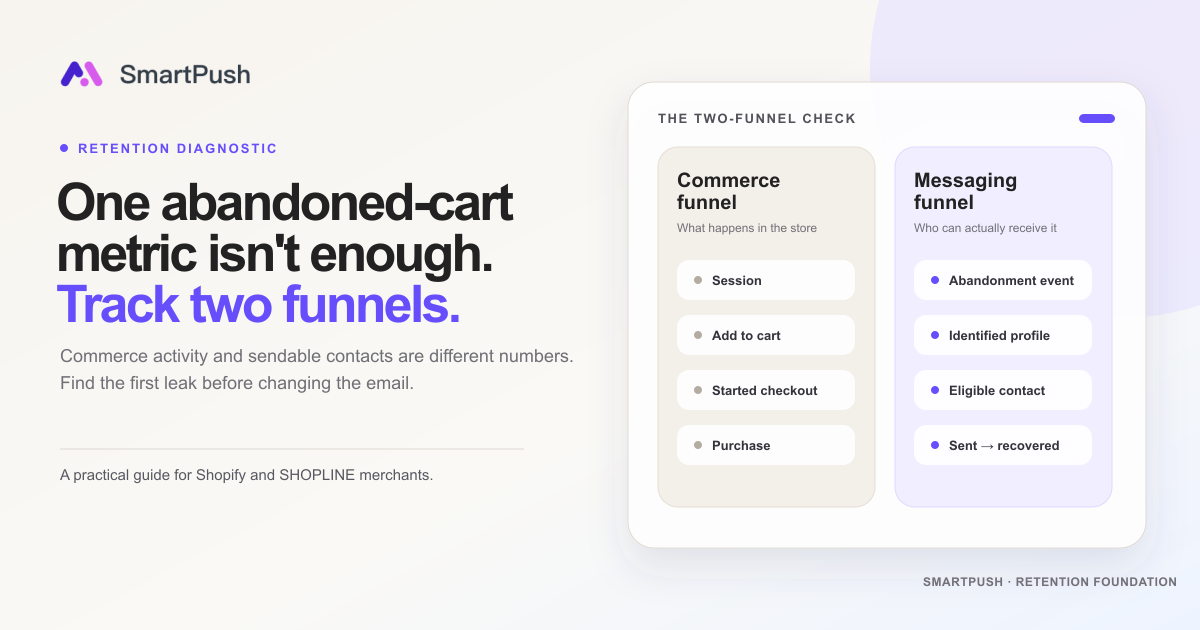
A high cart-abandonment count does not automatically create a large recoverable-email audience. Store analytics describe a commerce funnel; an automation can act only on a narrower messaging funnel of identified, eligible recipients who match the trigger and are not suppressed.
That is why low send volume is usually a diagnosis problem before it is a copy problem.
This diagnostic applies to Shopify and SHOPLINE merchants comparing storefront abandonment with email sends. It is useful before changing copy, adding a discount, or moving platforms.
Commerce funnel: Session → Add to cart → Started checkout → Purchase
Messaging funnel: Abandonment event → Identified profile → Eligible profile → Trigger matched → Message sent → Delivered → Recovered order
Comparing total cart abandonments with emails sent mixes two different denominators. Start by deciding which abandonment event the flow actually uses: browsing, cart, or checkout. These are different audiences.
A cart event can exist without an email address or recognised customer profile. Record qualifying abandonment events, identified profiles, unidentified profiles, and identification rate. If identification is the largest leak, changing copy will not solve it; review where the store asks for an email and whether returning customers are recognised consistently.
An identified profile is not always sendable. Check marketing-consent state, channel support, region, and whether the flow is designed for all eligible checkout contacts or marketing subscribers only. Treat a consent rule as a rule, not as an unexplained tracking failure.
For the chosen automation, check: active status, audience conditions, delay, reset behaviour after a newer cart or checkout, completed-purchase exclusions, sales-channel eligibility, product availability, and duplicate flows. If profiles never enter the workflow, the fault is upstream of email content.
For a recent sample of qualifying profiles, record entered, skipped, sent, bounced or failed, delivered, and the reason code. If profiles enter but messages do not deliver, investigate sender authentication, invalid addresses, suppression, and deliverability. If they never enter, go back to trigger and eligibility.
Track counts and rates for each stage.
Identification rate = identified / qualifying abandonment.
Eligibility rate = eligible / identified.
Send rate = sent / eligible.
Delivery rate = delivered / sent.
Recovery rate = recovered orders / delivered.
The largest absolute leak tells you what to fix first. Low delivery points to deliverability; low send rate points to logic; low identification points to the customer journey; low recovery with healthy delivery points to timing, offer, message, or checkout experience.
Change platforms when the current system cannot express the segmentation, workflow, reporting, or channel coordination you need. A new tool does not create identity or consent that the store never captured. Run the same two-funnel scorecard for two to four weeks before treating a migration as the answer.
No. They are different events and may create different eligible audiences.
The gap is usually identity, eligibility, trigger scope, suppression, or delivery.
Yes as a diagnostic model, but event and consent behaviour must be checked against the store’s own SHOPLINE setup.
Build the two-funnel worksheet before the next campaign review. If the team cannot connect storefront events to sendable profiles after the audit, request a retention review.
Reviewed July 29, 2026.
.png)